Health and Safety Policy for Business Waste Removal Regents Park
 Purpose and scope: This Health and Safety Policy sets out the standards and procedures for business waste removal in and around Regent's Park areas, focusing on safe commercial rubbish collection and responsible waste removal services. It applies to all employees, subcontractors and visitors engaged in contract waste removal, commercial waste clearance and business rubbish disposal operations. The policy aims to protect people, property and the environment while ensuring compliant, efficient service delivery.
Our objectives include reducing accidents, preventing ill health, and minimising environmental harm during every stage of the refuse removal and site clearance process. We commit to risk-based planning for each job, adequate resourcing for safe rubbish collection, and continuous improvement through monitoring, auditing and staff consultation. Safety is an operational priority for every rubbish collection and business waste clearance task.

Responsibilities
Senior managers are responsible for implementing the health and safety policy and ensuring that business waste collection teams have appropriate resources, training and supervision. Site supervisors must carry out pre-task risk assessments and ensure employees follow safe systems of work. Employees and operatives must work safely, use suitable personal protective equipment (PPE) and report hazards, incidents or near misses promptly to maintain safe commercial waste removal practices.Risk assessment and control measures
Risk assessments will be carried out for all rubbish removal operations, including manual handling, vehicle loading, segregation of recyclables, and removal of bulky commercial waste. Controls include job-specific method statements, exclusion zones during loading, appropriate equipment for bulky items, and safe access arrangements. The policy emphasises hierarchy of controls: eliminate or reduce hazards where possible, substitute unsafe practices, and engineer controls before relying on PPE.For hazardous or unknown wastes discovered during clearance, teams will stop work and follow a predefined procedure to isolate materials safely. Our waste removal staff are trained to recognise hazardous substances, follow containment steps, and notify management so that qualified handlers or licensed waste carriers can manage disposal. We avoid unnecessary exposure to chemical or biological risks associated with refuse collection and clearance.
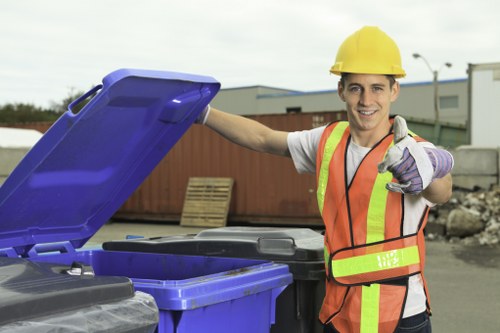 PPE and equipment: All personnel must be issued with and wear appropriate PPE for business rubbish collection, including hi‑visibility clothing, safety footwear, cut‑resistant gloves and eye protection where needed. Operators using lifting equipment, trolleys or compactors receive specific instruction on safe use. Vehicles used in waste removal are inspected daily and maintained to industry standards to prevent mechanical failures that could cause accidents during commercial waste removal jobs.
Manual handling controls are a core part of this policy. Teams use correct techniques and mechanical aids to avoid musculoskeletal injuries. Tasks likely to involve heavy lifting are planned and, where necessary, carried out by two or more operatives or using lifting appliances. Ergonomics and safe lifting are integral to our standard operating procedures for business waste removal and rubbish collection activities.
Traffic and vehicle safety: When loading and transporting business waste, drivers and loaders follow traffic management plans to protect workers and members of the public. Vehicles are loaded to safe limits and secured to prevent shifting. Reversing is minimised and banksmen used where visibility is restricted. All drivers hold appropriate licences and complete vehicle checks before every shift to support reliable waste removal services.
Waste segregation and environmental protection: We separate recyclable materials, general refuse and hazardous wastes at source to reduce contamination and promote reuse. Spill kits and containment materials are provided for operations that risk environmental release. The policy supports responsible disposal routes and licensed waste transfer for non-recyclable or controlled materials encountered during commercial rubbish clearance.
 Training and competency: All staff involved in business waste removal receive induction training, job‑specific instruction and periodic refresher courses. Training covers safe handling, PPE use, hazard recognition, incident reporting and emergency response. Supervisors are provided with additional leadership and hazard control training to ensure consistent safety standards across rubbish removal operations.
Incident reporting and emergency procedures are clearly defined. Any accident, injury or near miss is reported immediately and investigated to identify root causes and corrective actions. Emergency plans include first aid provision, spill response and arrangements for dealing with hazardous discoveries during a clearance. Lessons learned are shared with teams to prevent recurrence.
 Monitoring, audit and review: Management will monitor compliance through workplace inspections, safety audits and performance metrics specific to business waste collection services. Records of risk assessments, training, vehicle maintenance and incident reports are maintained. This policy is reviewed annually or whenever significant changes occur to work activities, legislation or best practice for waste removal and refuse management.
Contractor and site management: Where subcontractors or third parties are employed for commercial waste removal, they must demonstrate equivalent health and safety standards and adhere to this policy when operating on behalf of the organisation. Contract terms include safety expectations, verification of competence and mechanisms for performance monitoring during rubbish removal projects.
Worker involvement: We encourage active employee participation in safety matters through toolbox talks, safety meetings and suggestion systems. Workers are empowered to stop work if they believe an activity presents an unacceptable risk. Collective engagement improves risk awareness and supports the continuous improvement of waste removal safety practices.
Conclusion: This policy establishes minimum expectations for safe and sustainable business waste removal in the service area. By implementing robust risk controls, ensuring competence and maintaining clear procedures for handling hazardous or unexpected materials, we deliver reliable, compliant and safe commercial waste services while protecting people and the environment.
- Key elements: risk assessments, PPE, vehicle and traffic safety, hazardous waste controls, training and records.
- Commitment: continuous improvement and compliance with health and safety principles for all rubbish removal and business waste clearance activities.
